
What Does Disaster Relief Sanitation Include?
A disaster response setup usually means standard porta potty rental units grouped near shelter points, at least one ADA accessible porta potty per cluster, and a handwashing station rental or two nearby. OSHA 1926.51(c) sets the baseline ratio relief coordinators lean on: 1 toilet for 20 workers or fewer, then 1 toilet seat and 1 urinal per 40 workers as headcount climbs past that. That standard was written for construction crews, but emergency management teams use the same math for shelter populations because nobody has published a better number.
Each standard unit holds a 60 to 70 gallon tank and stands about 92 inches tall, small enough to stage in a parking lot, a school yard or a church lot without needing a permit review in most disaster declarations. If the situation involves flooding near septic systems, we also run septic pumping service calls and can bring a holding tank rental for sites where the sewer connection is down entirely. Water access matters too. OSHA 1926.51(a)(1) calls for an adequate supply of potable water at any place of employment, and that rule does not pause because the power grid did. For sites near Port Hueneme, 3.9 miles south of Oxnard, or Channel Islands Beach, 3.5 miles southwest, we can stage from either direction depending on road closures.
How Fast Can You Deploy Units in an Emergency?
Same-day and next-day placement is typical once we confirm site access and headcount. For emergencies outside business hours, emergency porta potty rental requests get priority routing, and we treat any request tied to disaster response the same way we treat a broken water main: it jumps the queue. A dumpster delivery needs about 60 feet of straight clearance behind the truck, so if debris removal is part of the response, tell us that up front so we send the right size. Roll-off dumpster rental units for storm debris pair well with sanitation drops, and a lot of relief sites end up ordering both in the same call.
We also bring light tower rental units and a temporary power pole when a shelter site has no working electrical service, since restroom trailers and handwash stations both need power for lighting and pumps. If the deployment runs past a few days, ask about monthly porta potty rental terms instead of paying day rates the whole time. Shelters that expect a longer stay sometimes add a restroom trailer rental once the first wave of portable units is in place, because trailers hold up better for extended, higher-traffic use.
Where Do Units Get Placed During a Response?
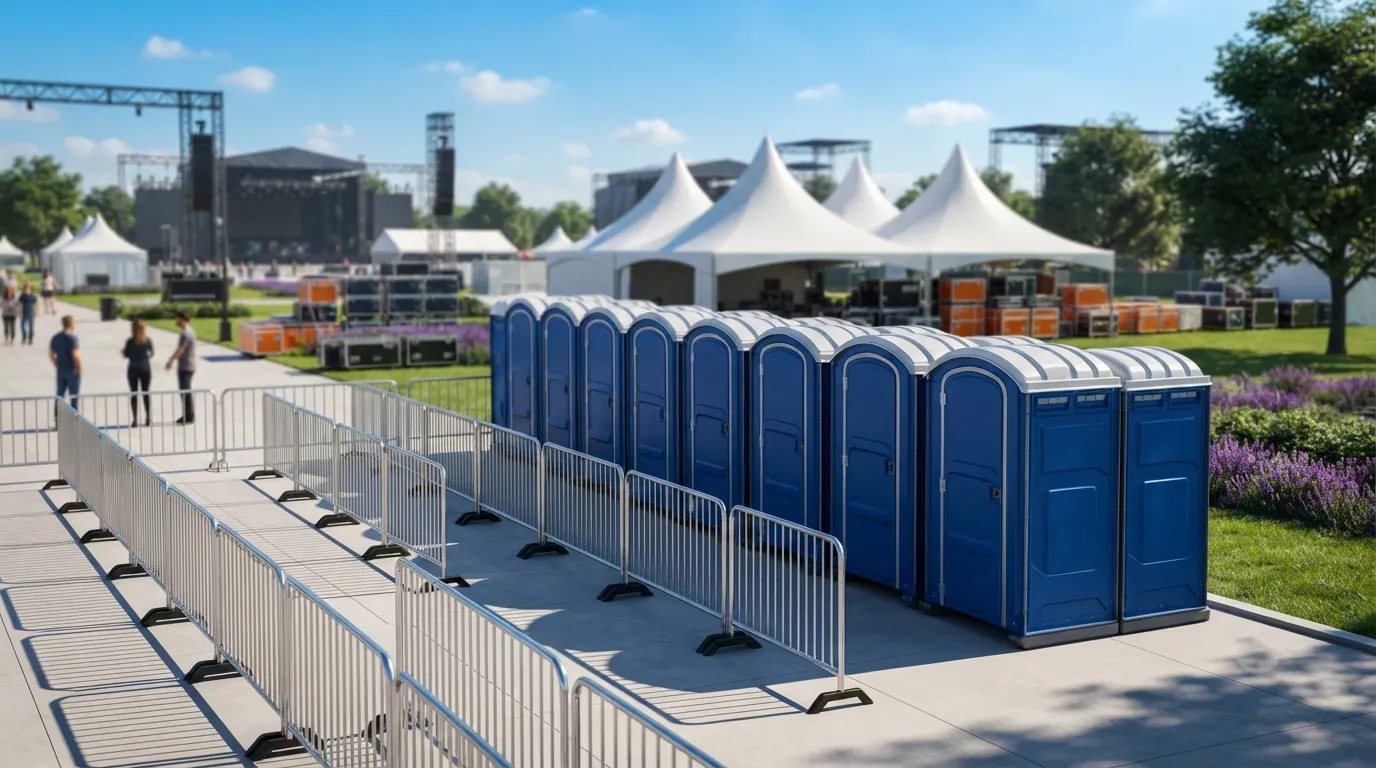
Placement follows the same logic as any event: firm, level ground, clear path for the service truck, and enough distance from food or medical tents to avoid odor drift. ADA Standards section 302.1 requires floor and ground surfaces to be stable, firm and slip resistant, which matters even more on a disaster site where the ground may be muddy or uneven. Our porta potty placement guide covers the general rules, and the same clearances apply to a shelter parking lot as they do to a job site: ADA Standards section 403.5.1 calls for a 36 inch clear route, and section 404.2.3 sets the minimum door opening at 32 inches, so units need to sit somewhere a wheelchair or a stretcher can reach them.
For clustered units, ADA Standards section 213.2 requires at least 5 percent to be accessible, never fewer than one. We also set up temporary fence rental around larger staging areas to keep foot traffic organized and to protect equipment overnight. If the response site sits near El Rio, 6.0 miles northeast of Oxnard, or stretches toward San Buenaventura (Ventura), 7.7 miles northwest, we can split a delivery across both locations in one dispatch run rather than sending two separate trucks.
How much does emergency portable toilet service cost?
Standard units run in the same day-rate band as any rental, generally 100 to 350 dollars a day depending on demand and how fast you need delivery. Emergency and disaster response calls sometimes carry a rush fee on top. Check porta potty rental cost for the full breakdown before you commit to a headcount.
Do you provide handwashing stations without running water?
Yes. Our handwashing units are self-contained with their own water supply, no hookup needed. 29 CFR 1910.141(d)2) requires soap and towels or a hand-drying device at any washing station, and hand sanitizer alone does not satisfy that. We stock both.
Can you deliver to a shelter site with no address yet?
Yes, we work off cross streets or GPS coordinates when a formal address is not assigned yet. Just give us the closest intersection and a contact on site who can meet the driver.
What happens if the septic system fails during a disaster?
We dispatch a septic truck the same way we would for any emergency call. See emergency septic service for response details, or septic tank warning signs if you are not sure the tank has actually failed.
Do you serve towns outside Oxnard during a regional disaster?
Yes. We already run routes to Santa Paula, 17.0 miles northeast, and Moorpark, 23.1 miles east. Check service areas for the full list or call and we will confirm response time for your exact location.
Next step
Get a delivery date
Tell us the address, the dates and the headcount. We size the order and confirm the route.